
Dynamic pricing has become a flashpoint in retail. When Wendy’s floated the idea of surge pricing for digital menu boards in 2024, the backlash was immediate, even though the story had nothing to do with electronic shelf labels. In retail, though, it shaped the conversation around ESLs anyway. Since then, operators evaluating the technology have had to answer the same question: Does this mean prices will start changing constantly at the shelf?
In most retail environments, the answer is no. Electronic shelf labels are not surge-pricing tools. They are a way to keep shelf prices accurate, synchronized, and operationally controlled. That distinction matters because the real value of an ESL system is not price volatility. It is pricing accuracy, promotion execution, labor savings, and customer trust.
Why Shoppers Are Connecting ESLs With Dynamic Pricing In 2026
The surge pricing story broke into mainstream media at a moment when consumers were already primed to distrust pricing changes; years of post-pandemic inflation had made every price movement feel personal. The images of digital menu boards flickering to new prices gave people a mental shortcut, and that shortcut stuck: digital display equals automatic price manipulation.
Electronic shelf labels got caught in the same frame. If a grocery store had ESLs, the assumption became that prices could, and might, change based on time of day, traffic patterns, or algorithmic signals the shopper couldn’t see or predict.
That assumption is worth addressing head-on, because it’s almost entirely wrong, and the distinction matters operationally, not just as a PR concern.
Dynamic pricing in retail stores means something different depending on who’s talking about it. For consumer advocates, it often signals unpredictability. For retail operators, it should signal control: the ability to update prices accurately, efficiently, and consistently with business decisions that have already been made. ESLs are the infrastructure that makes that second version possible.
What Electronic Shelf Labels Actually Do
At their core, electronic shelf labels are digital displays mounted at the shelf edge, each tied to a specific product in your pricing system. When a price changes in your POS, ERP, or pricing platform, the matching label updates automatically. The shelf stays aligned with the system of record without printing, distributing, or manually replacing tags.
In practice, many of the biggest benefits of ESLs show up in three areas:
- Pricing accuracy: The shelf always shows what the POS charges. Discrepancies between the two are one of the most persistent operational problems in retail; they generate customer complaints, erode trust, and, in some markets, create compliance exposure. ESLs eliminate the root cause by automating the sync.
- Labor efficiency: Pricing teams and store associates no longer spend hours each week printing and replacing paper tags. That labor redirects to the floor, the customer, and the parts of the operation that actually drive revenue.
- Promotion execution: A promotion that’s entered into the system goes live on every shelf simultaneously: no partial rollouts, no aisle-by-aisle delays, and no stale tags left behind after the promo ends.
None of that is dynamic pricing in the surge sense. It’s automated price accuracy, a fundamentally different capability and one that most retail operations need far more urgently than algorithmic price elasticity.
The benefits of dynamic pricing, understood this way, are straightforwardly operational: prices that reflect current costs and promotions without the lag and error rate of a manual process. Retailers gain the ability to respond to supplier cost changes the same day they happen, execute flyer promotions at the scheduled minute, and retire markdowns cleanly when the window closes. That’s the version of pricing agility that drives measurable results.
Where ESLs Show Up Across Retail Segments
MarginMate works with retailers across grocery, convenience, specialty retail, furniture, liquor, and micro markets, where pricing mistakes show up fast at the register. In those environments, ESLs are not about changing prices for the sake of it. They are about making sure approved prices go live accurately across the store.
How Retailers Control Dynamic Pricing Changes With ESL Systems
In an ESL setup, “dynamic” just means prices can be updated without someone replacing tags by hand. It does not mean the system is making pricing decisions on its own. Those decisions still come from your POS, ERP, or pricing platform and follow the approval process your team already uses.
Here’s how that governance works in practice:
Pricing rules and approval workflows
Price changes are entered or approved in your POS, ERP, or pricing management platform, the same system your team already uses. The ESL platform connects to that system as a downstream integration, not an autonomous engine. Nothing reaches the shelf that hasn’t passed through your approval process first.
For retailers with structured pricing controls, that means your existing authorization tiers apply – a category manager can approve a promotional price, and a regional director can authorize a network-wide cost change. Neither happens without the workflow that’s already in place.
Scheduled and time-based execution
ESL systems support scheduled promotions, pricing that goes live at a specific date and time, then reverts automatically when the promotional window ends. A grocery operator running a weekend flyer special can set the promotion in advance, let it execute on Saturday morning, and have every label revert to the regular price Sunday night. No one touches the shelf.
This is also how retailers handle end-of-day markdowns on perishables, time-limited clearance events, and seasonal pricing transitions, all common in grocery, specialty food, and c-store environments.
Centralized control across locations
For multi-location operators, ESL systems for business give pricing and operations teams a centralized view of update status across every store. A chain-wide price change goes out simultaneously, and the system confirms which locations are current, without store managers making phone calls or submitting manual confirmations.
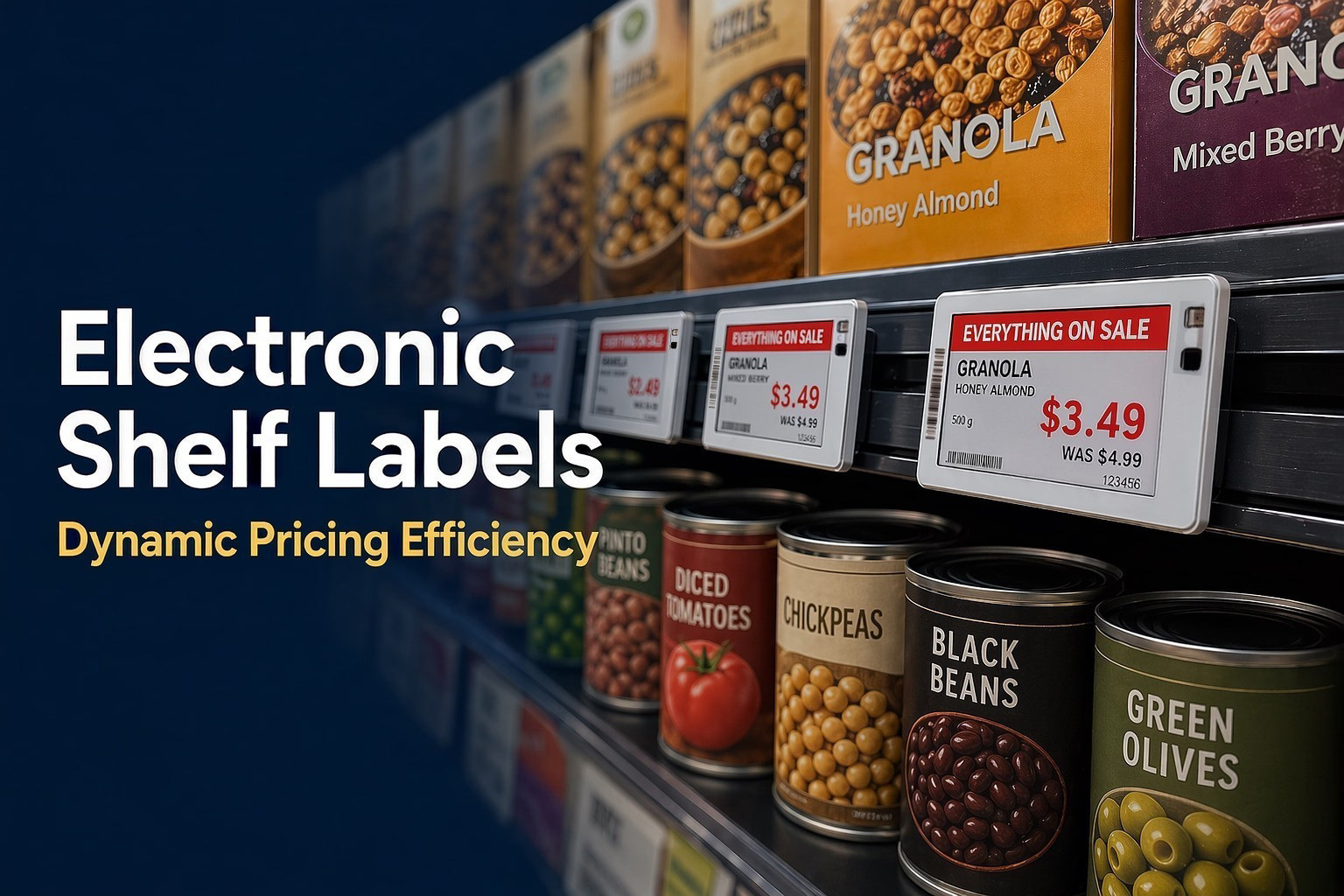
One of MarginMate’s largest customers runs an “Everything on Sale” event in all of their stores to coincide with major public holidays. And when they say “Everything” they mean it. Every ESL in every location changes to the sale price Friday night ready for the weekend, and at the end of the holiday every ESL returns to the pre-Everything on Sale price, whether it was on sale prior to the event or not. And nobody touches a single price label. The power of the Pricer ESL system coupled with MarginMate’s clean integration do all of the work.
How ESLs Improve Pricing Accuracy Without Harming Trust
Consumer trust in pricing is earned through consistency. The price on the shelf is the price at the register, every time, with no surprises. ESLs make that consistency structurally achievable in a way that paper labels never were, because paper labels rely on humans being accurate, fast, and thorough across thousands of SKUs every week.
The accuracy argument is also a trust argument. When a customer sees $4.99 on the shelf and $5.49 at checkout, the issue is not pricing strategy. It is an execution failure. ESLs reduce that gap by keeping the shelf aligned with the current POS price. That price synchronization, between your pricing system, the shelf edge, and the register, is what customer trust in pricing actually depends on. When it works automatically, it works consistently. When it depends on a manual process, it depends on human factors like being accurate under time pressure, across thousands of SKUs, every week.
Transparency in promotional pricing
ESL templates can display promotional context directly on the label, the regular price alongside the promo price, the promotional window dates, or “flyer price” designations that make it clear the shopper is seeing a temporary discount rather than a structural price change. That kind of shelf-edge transparency builds trust rather than eroding it.
A liquor retailer running an allocation-driven promotion, for example, can display the sale end date on the label itself, so customers know exactly what they’re seeing, and staff aren’t fielding questions about when the price goes back up.
Compliance and unit pricing
In markets with shelf-labelling compliance requirements, the benefits of ESLs extend directly to regulatory risk. Unit pricing fields – price per 100 g, per litre, per unit – update automatically when the base price changes, so compliance display is always current without a separate reprint process.
For grocery retailers managing thousands of SKUs across multiple departments, that eliminates one of the most labor-intensive compliance tasks in the operation.
Best practices for transparent ESL rollouts
The operational case for ESLs is clear. But how a retailer deploys and communicates the technology shapes whether customers and staff perceive it as an improvement or a source of anxiety. These practices consistently lead to smoother rollouts:
Compliance and unit pricing
Store associates who understand what ESLs do and what they don’t do are your best asset when customers ask questions. A brief pre-launch briefing covering the mechanics, the fact that pricing decisions still go through normal channels, and how to explain the system to shoppers goes a long way. Frontline staff who are confident in the answer are more effective than any in-store signage.
Use shelf-edge signage during transition
Particularly in grocery and c-store environments where shoppers are used to seeing paper tags, a brief transition period with “Now updated automatically” shelf cards or a short in-store explanation helps set expectations. It’s a minor operational step that significantly reduces the likelihood of customer confusion during the first few weeks post-launch.
Match label templates to shopper expectations
The way a digital label looks affects how shoppers interact with it. Templates that closely mirror the retailer’s existing price card design – same information hierarchy, similar formatting – create continuity rather than disruption. A furniture showroom displaying a high-ticket item’s price needs a different template than a C-store displaying a grab-and-go snack, and both can be configured to feel native to the environment.
Establish a clear governance policy
Before go-live, define who can authorize price changes, what workflows govern promotional pricing, and how the ESL platform connects to your approval chain. This is an internal governance question, not a technology question, but it’s the question that determines whether your pricing operation gets cleaner or more complex after deployment. A well-designed rollout surfaces and resolves this before the labels go on the shelf, not after.
Questions Retailers Should Ask Before Implementation
If you’re in the evaluation phase, these are the questions that separate a well-designed ESL deployment from one that underperforms, regardless of whose hardware is on the shelf:
- How does the ESL platform connect to our existing POS and pricing systems, and what does that integration actually require from our IT team?
- What happens during a network interruption or system downtime? Do labels freeze, display an error, or maintain their last known price?
- How does the communication infrastructure handle our specific store layout: metal shelving, freezer sections, high-density SKU areas?
- What is the rollout plan if we operate multiple locations, and how does store-level variation (different POS versions, fixture types, square footage) get handled?
- What does ongoing support look like after deployment: who do we call when a label goes offline, a template needs to change, or a system update affects the integration?
- What are the total costs of ownership over five to ten years, not just the hardware purchase price?
These questions depend on your store environment, your existing technology stack, your team’s capacity, and your rollout timeline. The right ESL partner should be able to walk through each one with specifics, not generalities.
That matters when comparing digital price tag suppliers. Some vendors focus mainly on selling hardware. A stronger partner should be able to speak clearly about integration, infrastructure, rollout planning, and support before a decision is made.
ESL Dynamic Pricing Is About Control, Not Chaos
Electronic shelf labels dynamic pricing efficiency isn’t a concept that belongs to a particular segment or company size. It’s the operational outcome when shelf prices are always accurate, promotions execute on time, and the labor cost of running a pricing operation scales with your business instead of your headcount.
For businesses ready to move beyond manual pricing, the important question is what an ESL rollout would require in their own stores. See how other retailers are using ESLs, or contact MarginMate to evaluate what rollout could look like in your environment.