
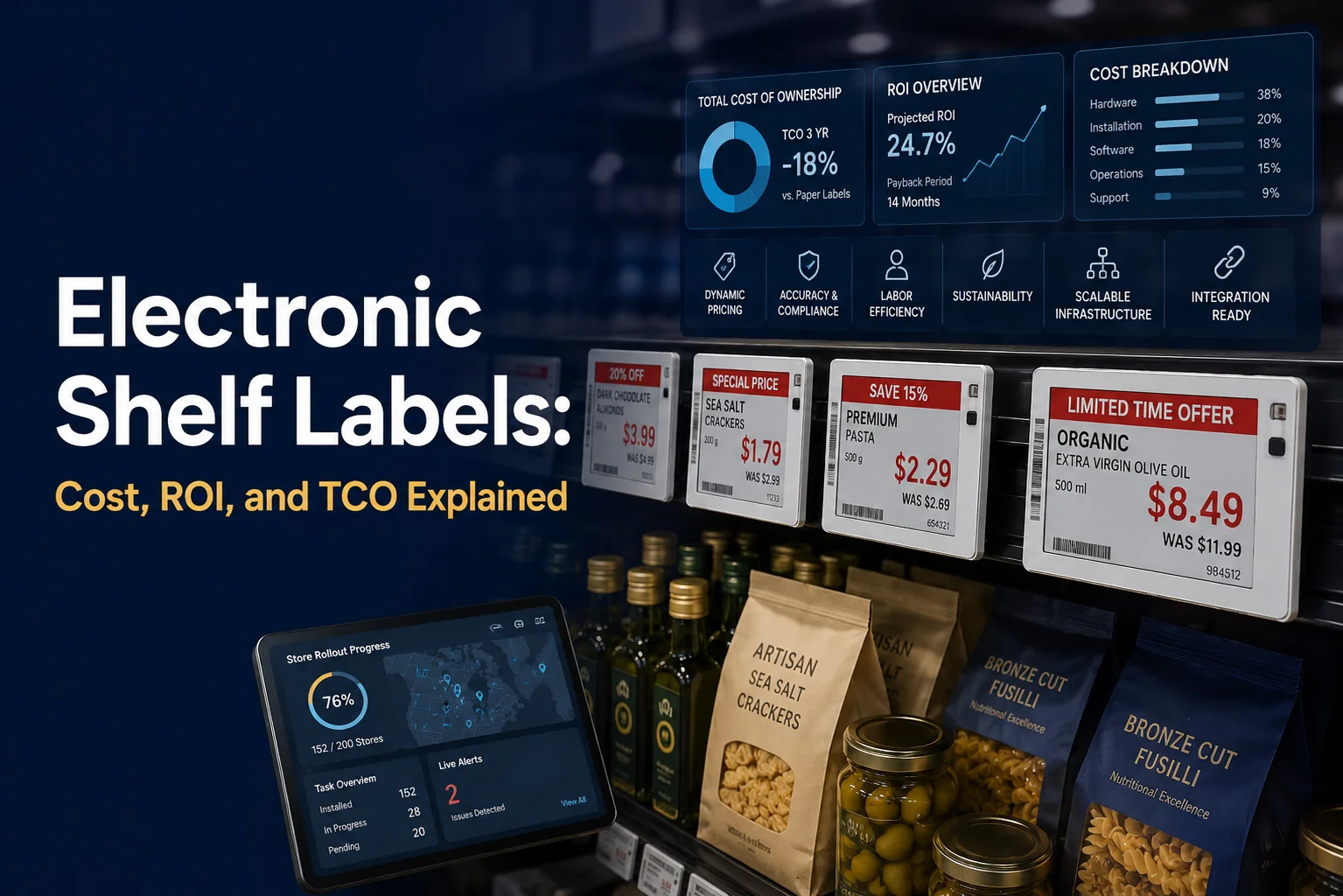
The first question most retailers ask about electronic shelf labels is how much they cost. It’s a fair question, but it’s rarely the most useful one on its own. A better buying decision starts with a broader question: what will the full ESL rollout cost to install, integrate, operate, and support, and what will it return over the life of the system?
Electronic shelf labels cost is not a single number. It is a set of cost categories shaped by store count, SKU volume, label mix, infrastructure readiness, technology stack, and operating model. Retailers who buy on label unit price alone often discover the true expense later: integration problems, inadequate infrastructure, limited support, or extra manual steps that keep adding labor and support costs long after launch.
In this article, we walk through the cost structure of an ESL deployment, how to frame the ROI case, what total cost of ownership actually includes, and which questions to answer before requesting a quote.
How Much Do Electronic Shelf Labels Cost?
Electronic shelf label pricing varies. For most retailers, the most useful evaluation looks beyond label unit price to total project scope and long-term operating expenses.
At a high level, an ESL investment usually includes:
- Label hardware
- Gateways, access points, or communication infrastructure
- Software or platform licensing
- POS, ERP, or pricing system integration
- Installation and project management
- Staff training
- Ongoing support, maintenance, and replacement planning
That full view matters because the lowest upfront hardware price does not always produce the lowest total cost of ownership.
What Affects the Cost of an ESL Rollout?
No two ESL projects cost the same, and the gap between a simple single-store installation and a complex multi-location rollout can be significant. The same variables that influence cost also determine whether the system delivers the labor savings, price accuracy, and operational control retailers expect.
Store Count and Layout
Infrastructure must be planned for every store. More locations can mean more site visits, installation labor, rollout coordination, and POS environment variation. Store layout also matters. Wide footprints, dense fixture configurations, refrigeration-heavy departments, metal shelving, and high-SKU areas can all affect the amount and placement of required communication infrastructure.
SKU Volume and Label Mix
A store with 500 SKUs has a fundamentally different cost profile than one managing 20,000. Label quantity drives hardware cost directly, but format mix matters too. A furniture showroom may need a smaller number of large-format labels, while a grocery retailer may require thousands of standard shelf-rail labels plus specialty formats for peg hooks, freezer doors, and display cases.
Network and Infrastructure Readiness
Some stores are ready to receive the ESL infrastructure immediately. Others require electrical work, cable runs, ceiling access, or layout adjustments before installation can begin. A site assessment should identify those requirements before a contract is finalized so the retailer understands the full rollout cost instead of discovering infrastructure gaps during implementation.
Rollout Model and Installation Complexity
A phased rollout across six stores is operationally different from a simultaneous rollout across sixty. Chain-wide rollouts require coordination and change management resources that add to the total project cost but also compress the timeline for realizing savings.
Hardware, Software, Infrastructure, and Integration Costs
A complete ESL system has several cost layers. Understanding each one is the only way to compare proposals accurately, especially when one vendor bundles services and another separates hardware, software, integration, installation, and support into different line items.
Label Hardware
Label units are usually the most visible line item, but the unit price alone is a misleading comparison point. Display size, battery technology, communication protocol, expected service life, and failure rate all affect what a label actually costs over time. A label with a higher upfront price may still produce a lower five-to-ten-year cost if it reduces battery replacement, service calls, and hardware failures.
Gateways and Access Points
The communication infrastructure that transmits pricing updates to labels must be installed throughout each store. Coverage requirements depend on store size, shelving density, and signal-disrupting materials such as metal fixtures and refrigeration systems. Infrastructure designed around those conditions helps prevent coverage gaps that create operational problems after go-live.
Platform and Software
The management software connects your pricing system to every label in every store. It handles integrations, manages templates, schedules promotions, and tracks update status across locations. Platform licensing models vary. Some are included in the overall project cost, while others are structured as annual SaaS fees. Clarifying what is included before purchase matters.
POS, ERP, and Inventory Integration
Integration with your existing retail pricing system is where many ESL projects encounter unexpected costs. Complexity depends on your POS platform, ERP configuration, centralized pricing engine, inventory data, and the quality of your pricing records. When that connection is handled well, approved price changes flow automatically from the system of record to the shelf. A poorly executed one creates manual processes that reduce, or even erase, the labor savings ESLs are supposed to deliver.
Project Management and Training
Planning, site assessment, and staff training are legitimate project costs. A deployment partner who handles this work helps reduce delays, training gaps, and go-live issues. Retailers who treat these steps as optional often face problems after launch that take weeks to resolve.
The Hidden Cost of Paper Shelf Labels
Paper labels are not free. Most retailers know that, but few have a clear view of what they actually spend because the expense is spread across labor budgets, printing supplies, error resolution, compliance work, and missed promotional revenue. Since those costs rarely appear as one visible line item, the cost of staying with paper is often underestimated when ESLs are being evaluated.
- Labor spent printing and changing labels: in a store managing thousands of SKUs with regular promotional cycles, price tag labor is a recurring weekly cost. Printing, distributing, and replacing labels occupy meaningful staff hours that could be redirected to customer-facing work. That cost scales with every location you add and every additional price change cycle you run.
- Pricing errors and customer trust: when a shelf price does not match the POS, someone absorbs the difference. In many markets, consumer protection rules require retailers to honor the lower price, making the cost of an incorrect label direct and immediate. A shopper who sees $9.99 on the shelf and $11.49 at checkout remembers the mismatch. Over time, those shelf-to-checkout discrepancies erode trust in ways that are difficult to rebuild.
- Promotion delays and compliance risk: a promotion that launches 48 hours late because tags were not changed is a margin that cannot be recovered. In markets with unit pricing requirements, a manual label process creates recurring compliance exposure. These costs do not appear in a straightforward paper-versus-digital comparison, but they are part of the true cost of staying with paper.
How Retailers Calculate ESL ROI
The electronic shelf label return on investment calculation is not one universal formula. It is a framework shaped by store count, SKU volume, price change frequency, labor costs, operating model, and integration requirements. Retailers get the most useful ROI picture when they build the business case from their own operational data rather than relying only on vendor averages. The categories below are especially relevant for grocery, convenience, specialty, furniture, liquor, and micro market retailers.
A simple starting point is:
Estimated ESL Payback Period = Total ESL Investment ÷ Annual Net Savings
Annual net savings may include labor hours reduced, pricing errors avoided, promotions executed on time, compliance work reduced, and support or maintenance costs accounted for. The more accurate the inputs, the more useful the payback estimate becomes.
Labor Efficiency
Start with the labor hours your team currently spends on pricing tasks each week: printing, distribution, tag replacement, price verification, and error correction. Apply your actual labor cost per hour and multiply that across your store count annually. That number represents one of the most direct and measurable savings ESLs can deliver.
Price Accuracy
Pricing error costs are harder to quantify but worth estimating. Cashier overrides, customer price complaints, and markdown adjustments tied to labeling errors all belong in the ROI model. In environments with unit pricing compliance requirements, potential fines and remediation costs should also be included.
Promotion Execution
How many promotions per year run late because label changes were not completed in time? Each represents lost margin. If you can estimate the revenue impact of promotions that launched 24 to 72 hours behind schedule, that is a recoverable value the ESL system can help capture.
Scalability Across Locations
This is where the business case strengthens most for multi-location operators. Manual pricing labor scales linearly with store count. ESL operational cost does not. Once deployed and integrated, pushing a price change to one location or fifty takes the same effort. The marginal cost of adding a store to a working ESL network is substantially lower than running that store on paper labels.
What Payback Period Should Retailers Expect?
It depends on your specific cost structure. Any vendor who provides a precise payback number without understanding your stores, SKU count, price change frequency, labor model, and integration requirements deserves scrutiny.
The variables that typically shorten the payback period include:
- High price change frequency
- Large SKU counts
- Multiple store locations
- Significant labor costs tied to pricing tasks
- Strong POS, ERP, or pricing system integration options
- Lower long-term maintenance requirements
A regional grocery chain running weekly flyer cycles across ten stores has a fundamentally different payback calculation than a single-location specialty retailer with stable pricing.
Technology choice can affect payback, too. Communication method, battery life, infrastructure requirements, and maintenance expectations all influence long-term cost. For example, a retail pricing system built on infrared communication operates independently of the store’s wireless environment, which can reduce infrastructure contention and simplify long-term maintenance planning. Battery life differences between label technologies also translate into meaningful cost differences over a five-to-ten-year horizon.
Rather than accepting a projected payback figure from a vendor, build the calculation from your own data: annual labor cost on pricing tasks, pricing error resolution costs, and a realistic integration timeline. That keeps the evaluation focused on the details that actually affect cost, timing, and payback.
Why the Total Cost of Ownership Matters More than Label Price
ESL ROI and TCO are related, but they are not the same thing. ROI asks what the system returns relative to its cost. TCO asks what the system actually costs to acquire, deploy, operate, support, and maintain across its full service life.
| Cost area | What retailers should evaluate |
|---|---|
| Hardware | Label quantity, format mix, battery life, replacement expectations, and failure rates |
| Infrastructure | Gateways, access points, coverage planning, installation complexity, and store layout constraints |
| Software | Platform licensing, template management, reporting, scheduling, and user access |
| Integration | POS, ERP, inventory, pricing engine, data quality, and ongoing integration support |
| Installation | Site assessment, labor, installation sequencing, and store-level variation |
| Training | Store associate training, admin training, and retraining as staff changes |
| Support | Post-launch troubleshooting, template updates, system monitoring, and service response expectations |
The label unit price is only one part of the cost picture. A lower-cost hardware proposal can become more expensive over time if integration is incomplete, infrastructure is underplanned, or post-launch support is limited. System problems and manual fixes show up in labor costs long after the initial invoice is paid.
On a ten-year TCO horizon, the questions that matter include the following:
- Expected battery replacement costs and how battery life varies across technologies
- Label failure rates over five to ten years, and the cost of replacement
- What ongoing support covers, what is billed separately, and who resolves integration issues affecting pricing
- Infrastructure upkeep requirements as the store evolves: fixture changes, new departments, layout updates
- Cost of re-training staff as turnover occurs or new system features are adopted
A partner with predictable support pricing creates a very different TCO picture than one that bills separately for every template change, support request, or integration issue.
A Simple ESL ROI Framework for Multi-store Retailers
Use your own operating data wherever possible. Vendor projections can be useful reference points, but they are based on averages that may not match your store environment, labor rates, price change frequency, implementation timeline, or integration requirements. This framework is a practical starting point, not a guaranteed payback calculation.
| Step 1: Current-state baseline | Document what you currently spend on pricing-related labor annually across all locations: printing, distribution, tag replacement, verification, and error correction. Add an estimate for pricing error resolution and promotion execution delays. |
| Step 2: Investment categories | Get itemized cost estimates across all major cost categories: labels, infrastructure, software, integration, project management, training, and first-year support. If quotes arrive as bundled totals, ask for the line-item breakdown. |
| Step 3: Quantifiable gains | Estimate the annual value of labor eliminated, pricing errors reduced, promotions executed on time, and compliance risk avoided. Be conservative. Underestimating projected savings keeps the business case grounded and makes the final ROI model easier to defend internally. |
| Step 4: Risk-adjusted payback | Divide total investment by annual net savings. Then adjust for integration complexity and implementation timeline. In a phased rollout, savings may begin as each location goes live, but a full return is not realized until every location is live and the system is operating as intended. |
| Step 5: Vendor and Support Questions | Before finalizing any evaluation, ask specific support and delivery questions: How is the integration handled, and by whom? What does post-go-live support cover? What is billed separately? What happens when a label goes offline, or a template needs updating? How are software updates managed? Has the vendor deployed in store environments similar to yours? |
Build an ESL Cost Model Around Your Stores
Electronic shelf labels deliver a stronger return when deployed correctly from the start. The right ROI model should account for more than label quantity. It should include infrastructure, integration, project timeline, training, support, and the operational savings your stores can realistically capture.
MarginMate has been deploying electronic shelf label systems since 2005, with more than 600 installations across six countries. The team supports POS and ERP integration, coordinating implementations across multiple locations and lifecycle support, all of which play a major role in whether the system delivers the savings and reliability retailers expect.
If you are building an ROI model or evaluating ESLs for your stores, contact MarginMate to review your store environment, technology stack, and operating goals. We can help you map out the actual costs, identify the likely savings, and decide whether ESLs are the right next step.